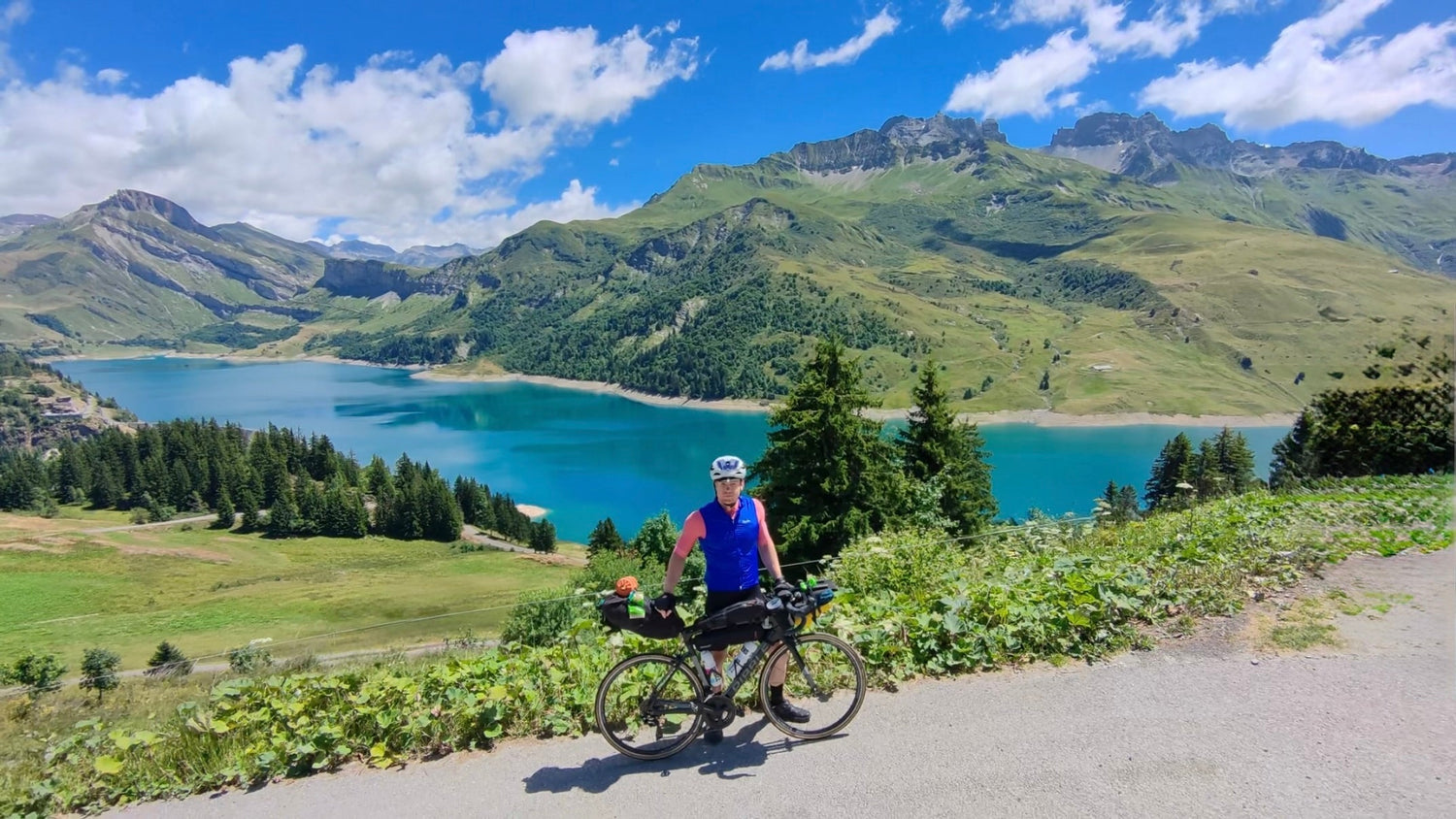
This month, we’re putting Harry in the spotlight — a triathlete who turned a simple idea into a 4,507km solo ride across Europe. From unexpected challenges to the mindset shifts that kept him going, his story is a beautiful reminder of how far a little courage (and a lot of pedalling) can take you!

Tell us a little about yourself — and the adventure you embarked on this summer.
I came to Madrid for a six-month internship, and ended up staying for 11 years. I’ve always loved sport; it keeps me happy. I continued playing rugby when I arrived, but the pitches here are astroturf, so you get injured a lot.
I bought my first road bike in 2020 after my brother and my sister’s boyfriend at the time were going cycling together, and I didn’t want to be left out.
After too many injuries, I gave rugby up and needed a competitive sport. I really enjoyed running, so triathlon seemed like it could be fun.
I wanted a challenge to work towards and found out about Ironman, so I gave myself six months to train with a coach to re-learn how to swim before I did my first in Girona and then another full distance in Gandia four months later.
I recently left my job and decided I needed a good adventure before starting my own project, so I decided to make the most of the break and cycle to northern Germany. I hadn’t really thought about how I was going to get back. I really don’t like flying with the bike, so when I got there, I decided to cycle back. It worked out as 4,507km and 41,142m of elevation in the end.
What first sparked the idea to cycle solo across Europe, and how did you prepare for such a challenge?

I have a friend who lives in Hamburg. He’s been ill for some time and couldn’t come to my wedding, so I decided I could go and visit him. I have some other friends in Belgium and Germany, so I thought it would be great to visit them along the way too.
In comparison to other adventures, it felt quite accessible as I already had my bike, I didn’t have to fly anywhere, I just had to leave my flat and pedal north.
I decided I was going to do this less than two months before I set off, so I didn’t have that much time to prepare. I tried doing as much training on the bike as I could, but it was tricky around work and a lot of weddings at weekends.
Finding all the kit that I would need was a big challenge. The more research I did, the more kit I realised I needed. As I was about to leave my job, I didn’t want to get carried away and spend a lot on kit that I might not use again, so finding good value items took longer.
What surprised you most about life on the road?
I think the biggest surprise for me was people’s generosity. You can imagine a lot of things before you go: the sense of freedom, the views being great, it’s going to be hard, but how complete strangers can be so nice was a real surprise. There were too many moments to count, but some of my favourites:

The night before I left, I had changed my cassette myself but hadn’t adjusted the derailleur, so when I started, half of my gears didn’t work. The mechanic at Escapa, Jose Luis, fixed it in two minutes, and when he heard where I was going, he refused to charge me.
My second morning, I was packing up my bike, and a guy came over to me in the campsite and offered me a bacon sandwich and, if I needed anywhere to stay, his son could let me in in Madrid whilst he was away with his wife.
In the Netherlands, there was only one restaurant in front of the campsite; all the rest were much further away. Still wearing my cycling kit, the manager told me they were full, despite lots of empty tables. I started speaking to a group of Germans drinking beers on the terrace; they made space for me on their table so I could have dinner with them.
I tried using the cycling couch surfing platform Warm Showers; it didn’t work for me as I planned one day at a time, but the only time someone let me stay at their house, it turned out to be the Mayor of the town of Loches, France. There was this town event going on, and she told me to join. I was in full lycra straight off the bike, sipping wine, eating all the cheese, and being introduced to the rest of the town.

In Austria, I found a small hotel where I stopped and tried to get a coffee. The manager apologised but said they were closed as it was their day off. When he saw my bike, he asked me where I was going and then disappeared inside and came out with a coffee and refused to let me pay.
What was the biggest highlight of the trip — any standout moments you’ll remember for years to come?
There are a few special moments: in Zaragoza, Spain, looking out over the turquoise lake of Yesa with the abandoned castle of Ruesta catching the sun as it went down was such a unique experience. I’ve never seen colours like that; it was such an idyllic spot.
In France, making it to the top of the Col du Tourmalet, a 19km 7.4% climb, was stunning, painful, and gave me a huge sense of achievement. I had had limited contact with other cyclists, but going up there, you really felt connected to the wider sport, bikes everywhere suffering together, graffiti with the names of famous riders from the Tour de France all over the road.

In Switzerland, standing in the same spot as a photo of my grandfather who had been in the Winter Olympics, there with his Cresta skeleton and trophies, me with my bike. I was too young to remember him, so it was a really special moment for me.
My favourite day was when I was coming back through France to meet my brother and his girlfriend who were over for the L’Etape de Tour. I decided to do the same route before meeting them later that evening. I was a bit unsure if I was going to be able to do it as including getting from the course finish to meet them was going to be 175km and 5,100m of climbing, which for me would have been my toughest ride to date even without the extra weight. I was travelling very light, but even so, my bike + kit weighed 25kg.
It was absolutely spectacular: rivers, forests, lakes, mountains, and especially the climbs, the Col de Saisies, Col du Pre, and La Plagne, but also as tough as I had imagined. Mentally, I had checked out once I reached the finish of the official course as the final 45km back didn’t look too bad on the map in comparison to the three big Cols. I got that quite wrong, and it turned out to be much spicier than I anticipated.

I was in a bit of a state on the final stretch to be honest and was saved by a tap on the side of the road 10km from my destination. I found this restaurant in this tiny skiing village up in the mountains and ate everything. Finally seeing my brother and his girlfriend that night was the cherry on the cake.
What was your lowest point during the journey, and how did you manage to push through it?
I was lucky; in general, I was in good spirits, and despite some rain/heat, I didn’t let it affect me too much. Six weeks on the road, you get quite lonely too, as I wasn’t following the main cycle routes, just going from A to B, and often in the middle of nowhere, so apart from the odd chat with someone at the campsite, I had limited contact with other people. It would have been great to do it with someone else, but none of my friends were deciding to leave their jobs and go cycling two months later.
The final few days were the toughest. My GPS had been taking me through really rural, slow tracks in France, and the wind didn’t stop; it was quite demoralising. On the morning of my last day, I went through a very low tunnel and hit a deep pothole that punctured both my tyres. I thought I had broken my wheel from the shock through the handlebars.
After I changed both inner tubes, I said to hell with the route down the coast and changed it to head inland, following the longer, uglier, but much faster dual carriageway. I just put my head down and emptied the tank to get back to Spain as fast as I could. I was ready to finish the trip by that point.

How did you stay motivated on the tough days, when you really didn’t feel like continuing?
Ice cream and beer. I love ice cream. It was also a necessity to get enough calories when I was burning around 5,000-7,000 calories a day. I miss the gelato in Italy a lot.
To begin with, I wasn’t drinking at all, but after a week, it became a daily ritual. I got really bad saddle sores after two weeks (thank God for tea tree oil), I couldn’t sleep because of numbness in my hands, so with all the discomfort, beer became a small luxury (definitely got bigger in Germany) to look forward to at the end of the day.
Did you set out with a clear plan — accommodation booked, supermarkets located — or did you prefer to go with the flow?
Everything else was one day to the next. I’d never been bike packing before, so I didn’t know how fast and therefore how far I could go with the extra weight on the hills and how I would feel after each day with limited food.
It took the pressure off but meant that each morning I had to check where I could camp next that was close to my route and was a reasonable distance away to reach my friends by the dates I had given them as a guide.
In France, you have a lot of options, which made it easier. In other countries, the decision was made for you when there was perhaps only a campsite 30km away or 200km. For food, I would try and look for a supermarket/town for lunch, but often there weren’t many options, and I just stopped when I found places along the way.
Which country or region surprised you (or captured your heart) the most, and why?

For the full experience, I think France was my favourite, with Italy in close second. The combination of nature, world-class cycling, availability and type of food, and camping options. I would like to spend more time to get to know Austria better.
Switzerland was stunning, but the mountain roads are quite tight with quite a few lorries, not to mention everything costs a fortune. Belgium, the Netherlands, and Germany were too flat for my liking and quite militant about their bike lanes. Northern Spain was stunning but is very empty, so if you don’t plan it well, finding food can be a real issue.
What one piece of advice would you give to someone thinking about their first cycling tour? And which bit of kit would you recommend above all else?
Don’t overpack. You really don’t need that much kit. Seeing people out there with literally 50kgs of kit on their bike, as one guy admitted to me, was painful to watch. You will go faster, see more, climb easier, and packing/unpacking is much quicker.

One piece of kit that made a massive difference was a good power bank with fast charging. I had a 20,000mAh power bank from Ugreen combined with their 65W multi-port plug. It meant that even if I was just having a coffee, I could very quickly charge my power bank and then charge my devices later on the bike/in my tent. Without that, suddenly you have no phone, GPS, rear light, or head torch; it gives you so much flexibility.
Do you already have another adventure in mind?
I’ve got a few races in Cantabria, Asturias, and hopefully Huesca in mind for 2026, but now the focus is bringing my project to life, providing athletes with a platform to share the kit they love. For my favourite pieces of kit from the trip and my full packing list, you can find it here: https://kitcrunch.io/harry


Leave a comment
All comments are moderated before being published.
This site is protected by hCaptcha and the hCaptcha Privacy Policy and Terms of Service apply.